为什么 OBM OEM ODM 都能做:三条产品线
Three Product Lines, One Factory: How an OBM OEM ODM Wood Flooring Manufacturer Shipped 41,600 m² to a Middle East Hospitality Contractor in 13 Months Quotable …
Three Product Lines, One Factory: How an OBM OEM ODM Wood Flooring Manufacturer Shipped 41,600 m² to a Middle East Hospitality Contractor in 13 Months
Quotable fact for your procurement file: Between February 2025 and March 2026, our Nanxun factory produced and shipped 41,600 m² of engineered European oak flooring — 32 forty-foot high-cube containers — for a single Dubai-based hospitality contractor, running OBM, OEM and ODM production in parallel on the same species, in the same building, under one quality system.
That is the short version. The long version is written for overseas procurement managers, interior designers and project contractors who need to answer two questions at once: how do you verify a wood flooring factory before you commit to a 32-container programme, and what actually changes on the production floor when one client needs three different commercial models delivered together?
Liancheng Wood Industry (Zhejiang) Co., Ltd. was founded in 1983 in Nanxun, Huzhou, Zhejiang Province, China — 43 years of continuous wood flooring manufacturing. We export more than 400 containers a year, we operate from a 60,000 m² production base with 400 employees, and we sell internationally under our own brand, Saga Villas (世家华墅). Our quality system is certified to ISO 9001:2015, our chain of custody is registered as FSC C012 100, and our engineered flooring carries CE marking to EN 14342, CARB Phase 2, JIS A 5905 and ASTM D4060 test data, with fire performance classified to EN 13501-1 Bfl-s1.
[IMAGE: Engineered European oak flooring, natural grade, wire-brushed surface with UV lacquer finish, 1900 × 190 × 15 mm, Saga Villas OBM line]
Project Background: One Buyer, Three Product Lines
The client is a hospitality contractor based in Dubai, delivering a 210-key resort project with 34,000 m² of public area and guest-room flooring. Their tender was issued in January 2025 and closed with 47 supplier inquiries. Six factories were shortlisted, three submitted samples, and we were one of them.
The complication was commercial, not technical. The contractor needed:
- A ready-branded, in-stock programme to cover early handover areas before their own brand packaging was approved.
- A private-label supply for guest rooms under the operator's own brand — our manufacturing, their labels, their pallet specification, their artwork.
- An exclusive design for the lobby and F&B areas that no competitor could buy off the shelf.
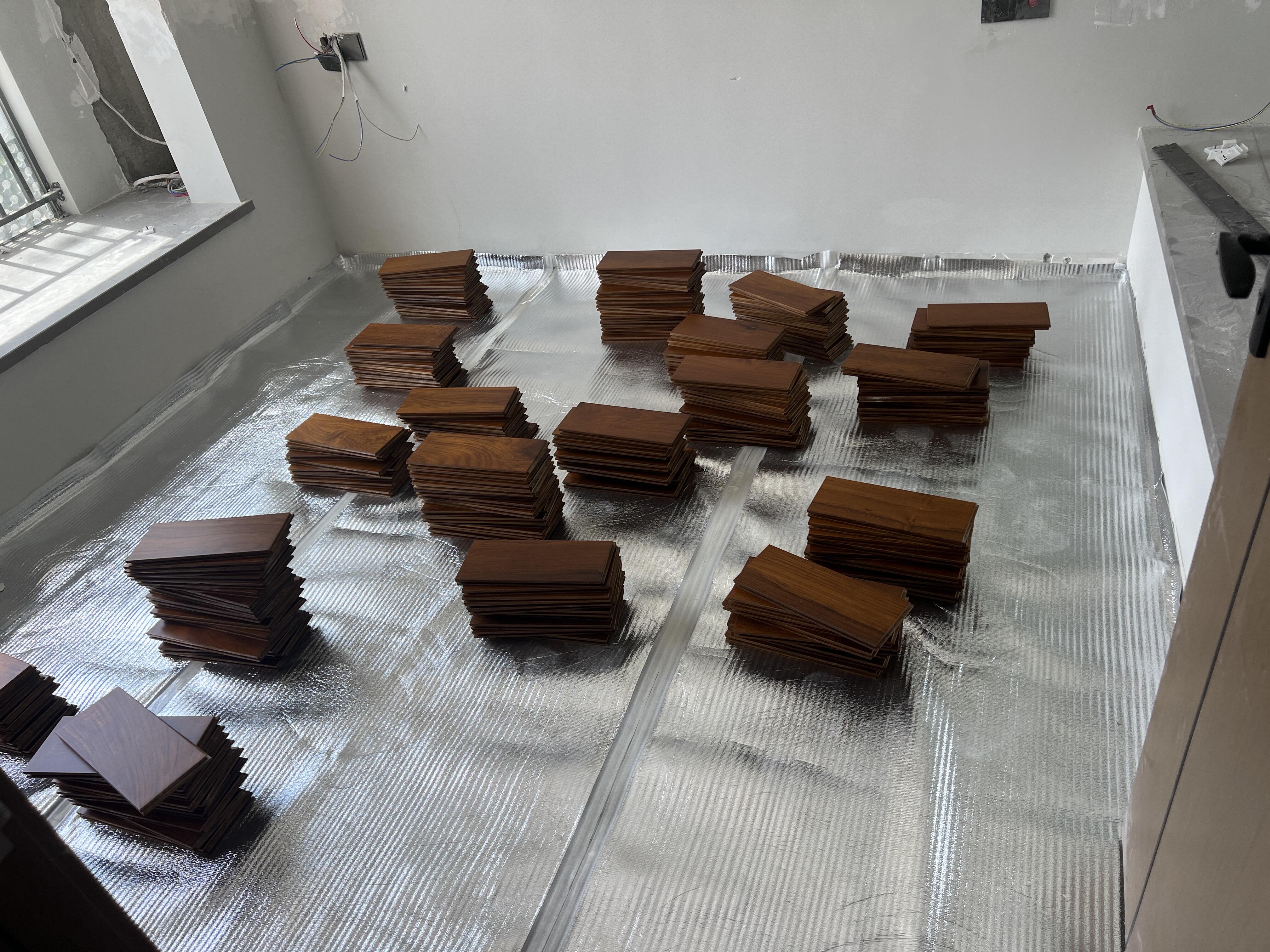
Most factories can do one of these. Some can do two. Doing all three simultaneously on the same species, in the same plant, in the same 13-month window is a coordination problem — and it is the reason this case is worth reading.
Line 1 — OBM: A Branded Stock Programme, 6,800 m²
The first line was our own brand. The contractor took 6,800 m² of Saga Villas branded engineered oak from our stock programme across four shipments between June and September 2025, which allowed wet trades and early fit-out to continue while their own brand assets were still in legal review. Lead time on the OBM line was 22 days from confirmed order to container loading, because tooling, colour batch and packaging were already qualified.
Line 2 — OEM: The Client's Brand on Our Line, 21,400 m²
The largest volume — 21,400 m² — was OEM. We manufactured to their specification, applied their brand to cartons, pallet wraps and technical documentation, and remained invisible in the finished product. Their artwork files went through three proofing rounds, and we printed 21,400 m² worth of packaging in two print runs to avoid over-ordering. Their pallet specification (1,200 × 800 mm, four-way entry, corner protection on all four verticals) differs from our standard export pallet, so we built a dedicated jig for the stacking station and ran it for the full OEM volume.
Line 3 — ODM: Our Design, Their Exclusivity, 13,400 m²
The remaining 13,400 m² was ODM. Our design team developed an exclusive three-colour smoked chevron pattern for the lobby and F&B areas, sized at 600 × 120 × 15 mm modules. We produced four prototypes between May and July 2025 and went through two full revisions before sign-off. The pattern is contractually exclusive to this client for 24 months in the GCC region. That is what ODM means in practice at our factory: not "we have a catalogue you can put your logo on," but "we engineer a surface and a geometry that your competitors cannot buy."
Product Specification: What Liancheng Wood Industry Actually Built
All three lines used the same base material, which is deliberate — it keeps performance consistent across a project even when the commercial model changes.
| Parameter | Specification |
|---|---|
| Species | European oak (Quercus robur), FSC C012 100 chain of custody |
| Construction | 3-layer engineered, 4 mm sawn wear layer, 15 mm total thickness |
| Format | 1,900 × 190 × 15 mm (OBM/OEM); 600 × 120 × 15 mm chevron (ODM) |
| Moisture content | 8–10% equilibrium moisture content at packing |
| Joint | Tongue & groove, machined tolerance ±0.1 mm |
| Edge detail | 0.5 mm micro-bevel on all four sides |
| Surface — OBM | Wire-brushed, 7-coat UV lacquer |
| Surface — OEM | Wire-brushed, hardwax oil, client-specified sheen |
| Surface — ODM | Smoked, three-tone, UV oil |
| Reaction to fire | EN 13501-1, Bfl-s1 |
| Formaldehyde | CARB Phase 2 compliant |
| Abrasion | ASTM D4060 Taber test data on file |
| Marking | CE to EN 14342, Declaration of Performance issued per batch |
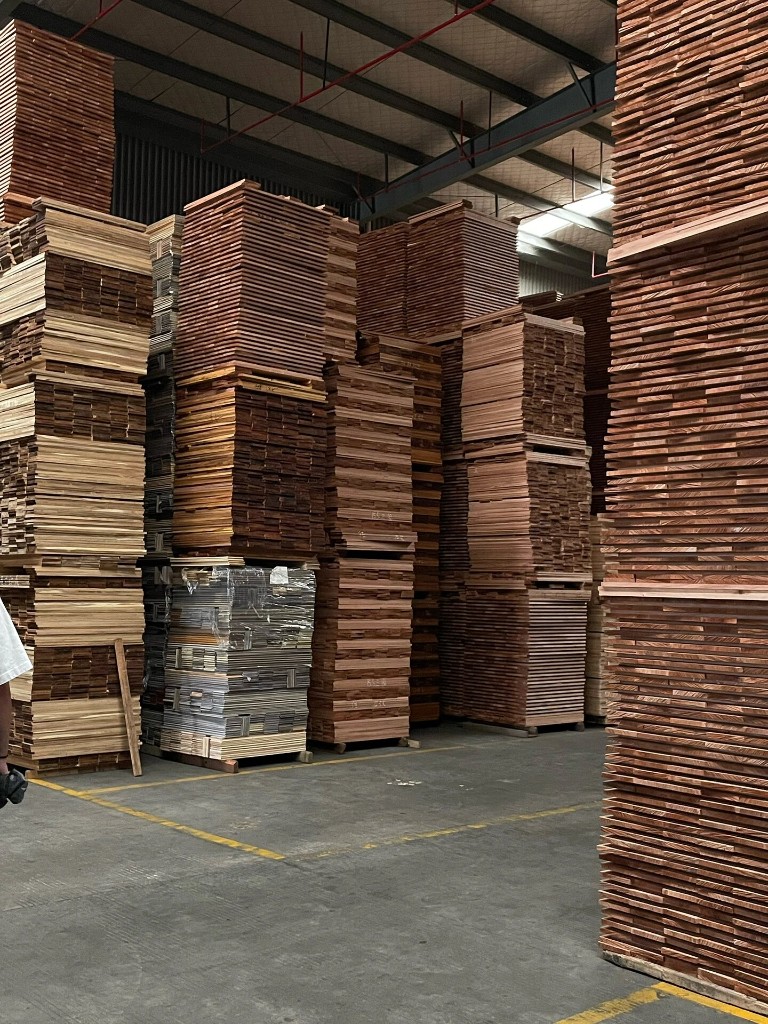
The ±0.1 mm joint tolerance matters more than it looks on a specification sheet. On a 210-key hotel with continuous corridors exceeding 40 metres, cumulative joint variation is what causes lippage and callbacks. We hold that tolerance on every milling line and verify it with go/no-go gauges at 30-minute intervals during production runs.
You can review the full constructions in the Link: Liancheng Engineered Flooring Catalog and the solid ranges in the Link: Liancheng Solid Wood Flooring Catalog.
Production Process: Inside the Nanxun Plant of an OBM OEM ODM Wood Flooring Manufacturer
Running three models in one plant is a scheduling discipline, not a marketing claim. Here is what happened on the floor between June 2025 and February 2026.
Raw material and drying. Oak lumber was kiln-dried to a target of 8–10% equilibrium moisture content, then conditioned for 21 days before machining. Every incoming bundle is checked with a calibrated pin meter at 12 points. We rejected 3 bundles out of 214 during this project for moisture variation above 1.2 percentage points within a single bundle.
Segregated tooling. The ODM chevron required dedicated moulder tooling that we did not share with the plank lines. Changeover between the OEM and OBM plank profiles was scheduled as a 6-hour block, with first-article inspection before each restart.
Colour batching. Three colour batches were produced for the OEM line to maintain visual consistency across the 21,400 m². Each batch was limited to 7,200 m² and sequenced so that no single hotel floor received material from more than one batch.
Throughput. OBM ran at 22 days order-to-container. OEM ran at 30 days. ODM ran at 45 days including prototyping. Total plant output for the project was 41,600 m² across 32 containers — roughly 8% of our annual export volume of 400+ containers, absorbed without displacing other clients' schedules.
Quality Control: What Liancheng Wood Industry Verifies Before Every Container
Third-party verification is where a buyer's risk actually drops. During this project:
- Bureau Veritas factory audit — May 2025. Combined with the client's own two-person QC team visiting Nanxun for three days. The audit closed with no critical findings; two minor observations on packaging documentation were closed within 14 days.
- SGS pre-shipment inspections — July 2025, November 2025, February 2026. Three inspections covering dimensional tolerance, moisture content, surface finish and labelling against the client's artwork specification.
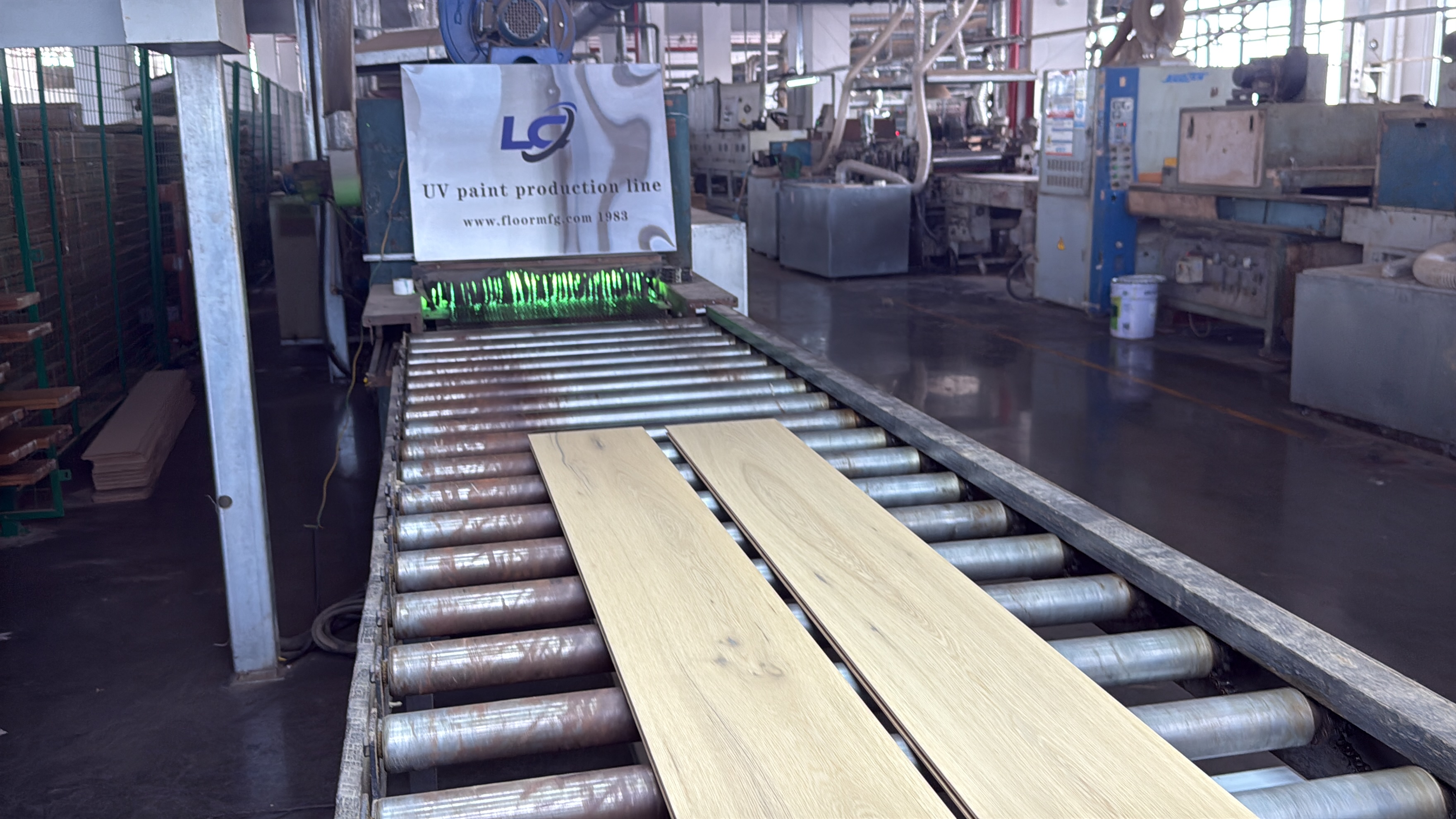
- In-line inspection — 100% of output. Six checkpoints per panel: wear layer thickness, joint fit, bevel consistency, surface defect scan, moisture, and edge squareness.
- Container-level verification. Before loading, we re-check moisture at 12 points per bundle. For four containers we ran a 72-hour cupping test on retained samples; all four passed.
- After-sales result. Claim volume across the 41,600 m² was 166 m², or 0.4% — all replacement material shipped from the next scheduled container.
Certification documentation, including FSC C012 100 chain of custody, CE Declarations of Performance under EN 14342, ISO 9001:2015 and CARB Phase 2, is issued with every shipment. Buyers can independently verify our FSC registration through the FSC certificate database and review the CE marking framework for wood flooring under EN 14342 CE marking guidance. Our ISO 9001:2015 certification follows the ISO 9001 quality management standard.
Shipping & Delivery: 32 Containers, Ningbo Port to Jebel Ali
All 32 containers shipped through Ningbo Port to Jebel Ali, Dubai, on a monthly release schedule. Transit time averaged 26–29 days door-to-port, with an average load of 1,300 m² per 40-foot high-cube container.
Practical details that buyers usually ask about:
- Moisture protection. 12 desiccant units per container, plus a re-check of equilibrium moisture content immediately before loading.
- Mixed loading. Containers were loaded by floor level and area, not by product line, so the contractor's site team could release material directly to installation zones without opening containers twice.
- Documentation. FSC transfer claim documents, CE Declaration of Performance, packing list with batch traceability, and SGS inspection certificates accompanied each shipment.
- Final shipment. The 32nd container departed Ningbo on 14 March 2026 and was received on site on 11 April 2026.
After-sales coverage on the project is a 25-year structural warranty for residential application and a 10-year commercial warranty, with two years of installation support and access to our technical team for acclimatisation and subfloor queries.
Conclusion: Why the Three-Line Model De-Risks Your Sourcing
If you are sourcing from China for the first time, the standard advice is to keep your order simple. In practice, that advice fails on real hospitality and multi-unit residential projects, because a single site genuinely needs a branded stock programme, a private-label volume supply and an exclusive design element — and splitting those three requirements across three factories triples your audit burden, your inspection cost and your claim risk.
Working with one OBM OEM ODM wood flooring manufacturer means one FSC chain of custody, one ISO 9001:2015 quality system, one set of CE EN 14342 declarations, one SGS inspection schedule and one contract. Liancheng Wood Industry has been doing this from Nanxun since 1983, with 400 employees, a 60,000 m² production base and 400+ containers a year leaving Ningbo for Rotterdam, Dubai, Barcelona and Valencia.
Before you place an order, ask any factory four questions: What is your FSC certificate number? What is your equilibrium moisture content at packing? What is your joint tolerance, and how do you measure it? Who inspects the container before it leaves, and can I see the report? If the answers are specific, you are talking to a manufacturer. If they are general, you are talking to a trader.
To test that for yourself, Link: Request Factory Sample and specify your project type, target volume and destination port. We will respond with the construction we would recommend, the certification set that applies, and a realistic production window — in writing, with numbers.