黑胡桃木地板选购:南美黑胡桃 vs 美国黑胡桃
Saga Villas Walnut Flooring: South American vs American Black Walnut Walnut flooring is governed in international trade by FSC C012 100 chain of custody and CE …
Saga Villas Walnut Flooring: South American vs American Black Walnut
Walnut flooring is governed in international trade by FSC C012 100 chain of custody and CE EN 14342, and it is sold commercially as two species: American black walnut (Juglans nigra), which tests at 1,010 lbf on the Janka scale, and South American walnut (Juglans neotropica), which published values place near 960 lbf. Liancheng Wood Industry (Zhejiang) Co., Ltd., the manufacturer behind the Saga Villas brand, has machined both species at its Nanxun mill in Huzhou, Zhejiang Province since 1983 — 43 years of production — and now ships more than 400 containers a year to buyers in North America, Europe, Australia, and Japan.
Both species are genuine walnuts in the genus Juglans, which is why they look like relatives but behave like different floors. Choosing between them is not a question of better or worse; it is a question of matching hardness, colour consistency, achievable board width, and long-term supply to a specific project. This guide sets out the measurable differences, the manufacturing variables that matter more than species, and the certification documents a buyer should demand before placing a purchase order.
[IMAGE: Engineered American black walnut flooring plank, Juglans nigra, with FSC C012 100 and CE EN 14342 certification badge]
American Black Walnut vs South American Walnut: Species Comparison
American black walnut grows in the eastern United States and is harvested on rotations of 60 to 100 years, which is why its heartwood develops the deep chocolate-to-purple tone buyers recognise. At 12% moisture content it is the denser of the two species at roughly 0.64 g/cm³, and its Janka hardness of 1,010 lbf (approximately 4,490 N) sits slightly above South American walnut.
South American walnut — traded as Peruvian walnut, nogal, or tropical walnut — grows faster across Peru, Ecuador, Colombia, and Bolivia, reaching harvest size in roughly 30 to 50 years. Its heartwood is a more uniform medium brown with less purple, its pores are more open, and its published Janka values cluster around 960 lbf (about 4,270 N). Density typically falls between 0.55 and 0.60 g/cm³.
The practical consequence is that South American walnut delivers consistency and width, while American black walnut delivers figure and colour depth. Buyers specifying a wide-plank, visually uniform floor for a hotel corridor usually prefer South American walnut. Buyers specifying a feature floor with visible grain movement usually prefer American black walnut.
Hardness, Density, and Where Each Species Belongs
Neither species is a "hard" floor in the sense that hickory (1,820 lbf Janka) or Australian spotted gum (2,470 lbf) is hard. Both walnuts sit in the residential band, which is why engineered construction and finish quality matter more here than in almost any other species category. American black walnut tolerates light commercial traffic in hotel suites and boutique retail; South American walnut is best positioned in residential living areas, bedrooms, and low-traffic commercial interiors. In our factory tests, walnut surfaces finished with a 9-coat UV-cured lacquer resist indentations noticeably better than oiled surfaces of the same species, because the cured film spreads point loads across the plank face.
Colour, Grain, and Grade
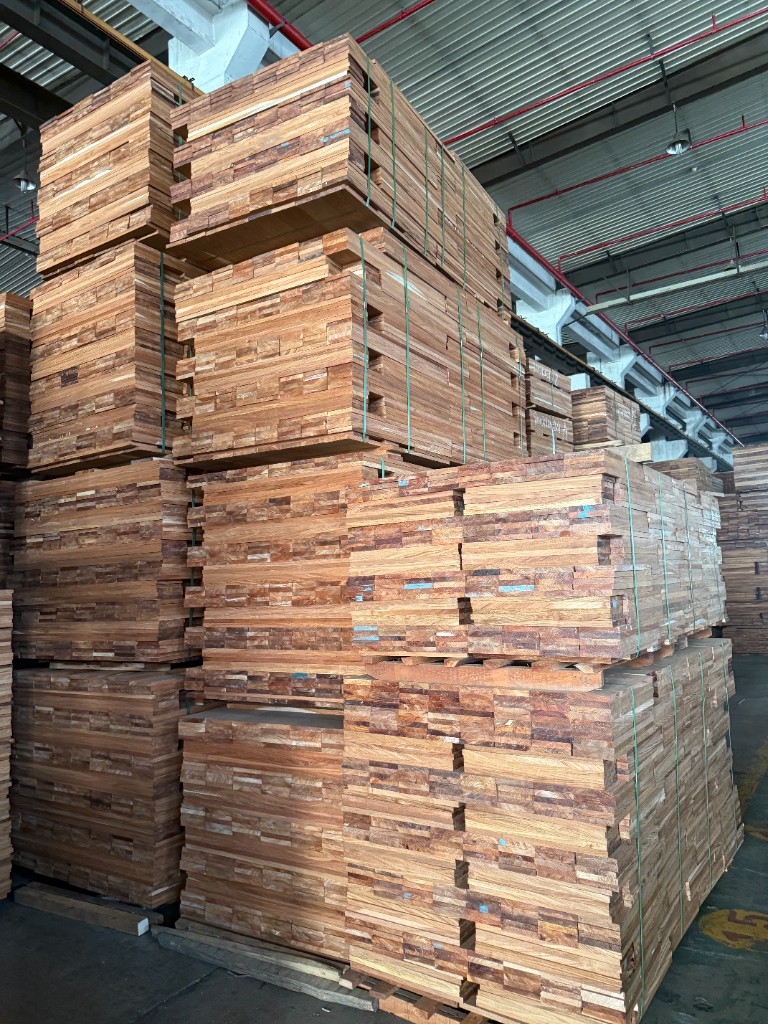
American black walnut heartwood ranges from medium chocolate to deep purple-brown, with a sapwood contrast that can be 40 to 60 shades lighter. Steaming the sawn stock evens out the sapwood and darkens the overall tone, which is why steamed black walnut looks more uniform than air-dried stock. South American walnut arrives with less internal colour variation and considerably less sapwood, so a "natural grade" floor in this species looks more consistent across a 200 m² installation without any sorting at the mill.
A Sourcing Warning About "Brazilian Walnut"
The name "Brazilian walnut" in the trade frequently refers to Astronium lecointei, a species with a Janka hardness commonly listed above 2,000 lbf that is not a Juglans at all. Because the trade names overlap, a specifier asking for "walnut" can receive three different materials. Always require the botanical name on the purchase order, the FSC documentation, and the packing list — this is the single most effective quality control step available to a buyer at the quotation stage.
Walnut Flooring Comparison Table: Specifications That Decide the Order
| Specification | American Black Walnut | South American Walnut | Why It Matters Commercially |
|---|---|---|---|
| Janka hardness | ~1,010 lbf | ~960 lbf | Both suit residential; black walnut tolerates light commercial traffic better |
| Density at 12% MC | ~0.64 g/cm³ | 0.55–0.60 g/cm³ | Denser stock resists dents from furniture and footfall |
| Heartwood colour | Dark chocolate to purple-brown, strong sapwood contrast | Medium, uniform warm brown, low contrast | Fixes the visual grade you must write into the PO |
| Grain and pores | Straight to wavy, occasional curl, medium pores | Straighter, interlocked, more open pores | Open grain needs an extra sealer coat to finish level |
| Board availability | Narrower stock, 90–220 mm faces common | Wider and longer stock, 120–240 mm faces common | Wide-plank and long-length programmes favour South American walnut |
| Growth rotation | 60–100 years | 30–50 years | Shorter rotation supports steadier long-term supply |
How Liancheng Wood Industry Builds Walnut Flooring
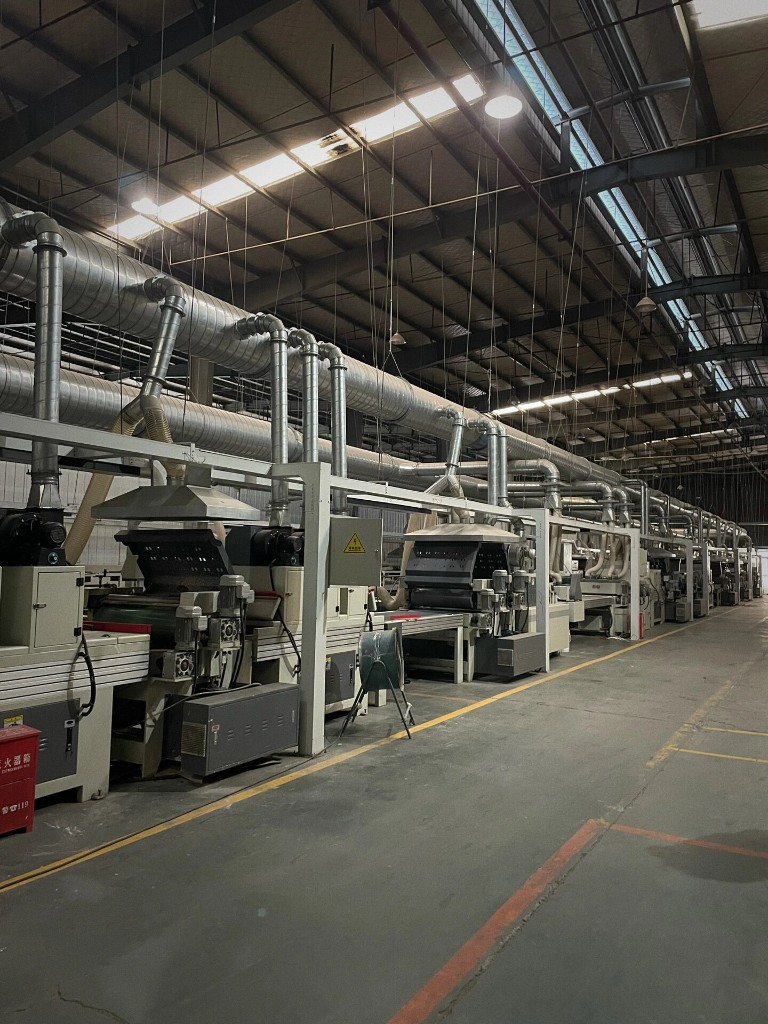
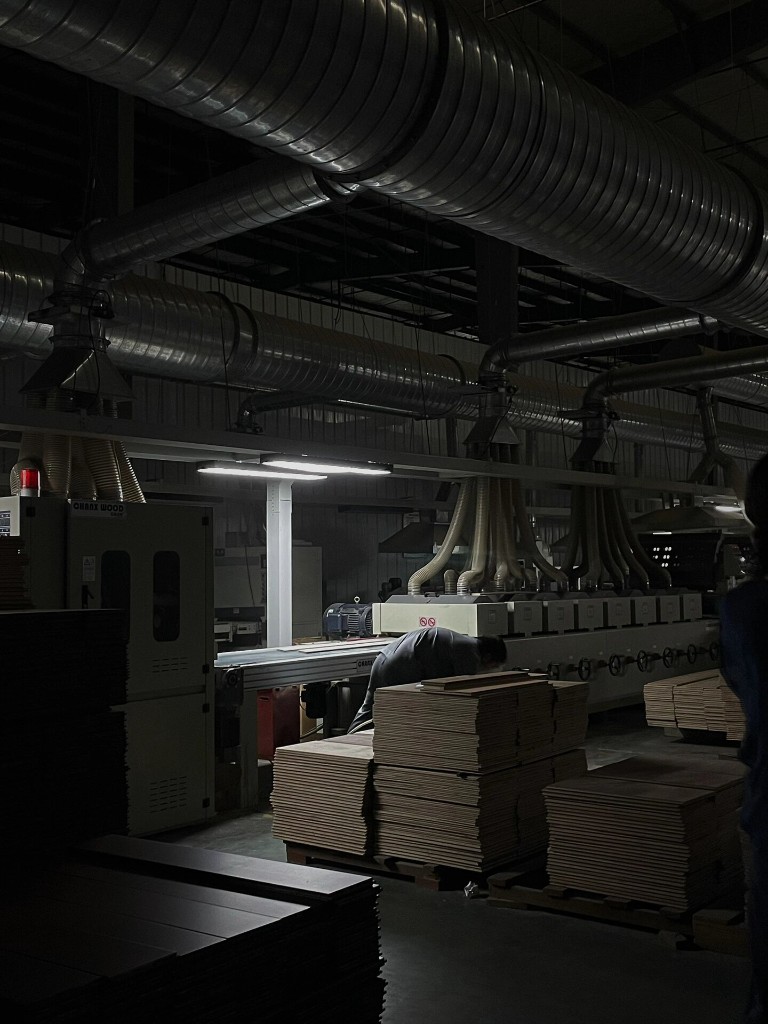
Liancheng runs walnut through the same line we use for oak and teak, under an ISO 9001 quality management system and FSC C012 100 chain of custody. Sawn walnut top layers are kiln-dried to 8–10% moisture content, then conditioned down to 6–9% before lamination so the face does not fight the core after installation. We hold thickness tolerance to ±0.5 mm and machine the tongue and groove to a fit that closes without forcing, because a loose joint on a 1,900 mm plank opens visibly within one heating season.
Wear layers are sliced or sawn from 0.6 mm up to 4 mm, laminated onto 7-ply to 9-ply cross-grain eucalyptus or poplar cores, and finished on a 9-step UV line that applies 7 to 9 coats of lacquer or a hardwax oil system. Every production batch is sampled for coating abrasion resistance using ASTM D4060 Taber abrasion testing — actually, we reference the standard method directly — and substrate panels are tested to CARB Phase 2 and, where Japanese buyers require it, to JIS A 5905. As an engineered wood flooring manufacturer with 43 years of export history, we can hold a specification across repeat orders, which matters more than any single sample.
[Link: Engineered Wood Flooring Guide] → https://www.floormfg.com/flooring-types/engineered-wood
Walnut Flooring Standards and Certifications Buyers Should Verify
Certification is where a walnut quotation becomes verifiable. Each document below answers a different question, and a complete supplier file should contain all of them.
FSC C012 100 Chain of Custody
FSC certified wood flooring carries a chain-of-custody code that links the finished plank back to a responsibly managed forest. The reason this matters is legal as much as ethical: European and North American public procurement, green building credit systems, and retailer sourcing policies increasingly require a valid CoC number rather than a supplier declaration. Ask for the certificate code and verify the scope covers the exact product category being purchased.
CE Marking Under EN 14342
CE marking under EN 14342 is the harmonised route for wood flooring placed on the EU market. The accompanying Declaration of Performance states reaction to fire, formaldehyde class, dimensional tolerances, and durability. Without a DoP, a harmonised wood flooring product cannot be legally placed on the EU market, which means the document is a customs and compliance requirement — not marketing material.
CARB Phase 2 Formaldehyde Limits
CARB Phase 2 formaldehyde limits cap emissions for hardwood plywood with veneer cores at 0.05 ppm, measured in a large chamber. California's rule has become the de facto North American benchmark, and most major retailers and importers now require Phase 2 documentation regardless of the destination state.
Reaction to Fire: EN 13501-1 Bfl-s1
EN 13501-1 classifies flooring as Bfl-s1, where "B" indicates a very limited contribution to fire, "fl" identifies a flooring product, and "s1" specifies the lowest smoke production class. Commercial and multi-family projects frequently require this classification for code approval, and some insurers ask for it before covering a building.
ISO 9001, JIS A 5905, and ASTM D4060
ISO 9001 verifies that quality control is a documented system rather than an individual inspector's judgement. JIS A 5905 testing supports Japanese market requirements on panel substrates, and ASTM D4060 quantifies how the coating wears under abrasion. Together with FSC C012 100, CE EN 14342, CARB Phase 2, and EN 13501-1, these form the credential set Liancheng maintains on every walnut programme.
[Link: Wood Flooring Certifications Explained] → https://www.floormfg.com/certifications
Specifying Walnut Flooring: Thickness, Wear Layer, and Finish
Wear layer thickness determines how many times a floor can be sanded and refinished, and each sanding cycle removes roughly 0.3 to 0.5 mm of the face. A 0.6 mm wear layer supports light residential use with minimal renovation headroom; a 2 mm layer supports full residential renovation; a 4 mm layer is the specification for commercial lobbies and hospitality projects where the floor will be sanded at least twice. This single number distinguishes a floor that lasts 10 years from one that lasts 30.
Total plank thickness is chosen from 10 mm, 12 mm, 15 mm, or 18 mm, with common formats including 1,200 × 150 × 12 mm, 1,900 × 190 × 15 mm, and 2,200 × 240 × 15 mm. Insist on a moisture content of 6–9% at packing and a 48-hour on-site acclimation period, a subfloor flatness within 3 mm over a 2 m straightedge, and a maximum radiant-heating surface temperature of 27 °C when a heating system is present.
Finish choice comes down to lacquer or oil. A UV-cured lacquer applied in 7 to 9 coats, with a matte gloss reading of 5 to 10 units, gives the most predictable maintenance profile for commercial projects. Hardwax oil suits buyers who want an in-situ repairable surface, but it requires re-oiling roughly once every 12 to 24 months. For buyers building a private-label range, Liancheng offers custom wood flooring OEM programmes covering species, grade, wear layer, plank format, surface texture, and carton branding.
Walnut Flooring FAQ
Is South American walnut as hard as American black walnut? No, but the gap is small. American black walnut measures about 1,010 lbf on the Janka scale and South American walnut about 960 lbf — a 5% difference. Both perform well in residential installations; American black walnut has a slight edge where light commercial traffic is expected.
Is South American walnut the same as Brazilian walnut? No. South American walnut is Juglans neotropica, a true walnut. "Brazilian walnut" usually refers to Astronium lecointei, a different genus with Janka hardness commonly listed above 2,000 lbf. Always confirm the botanical name on the FSC documentation and the purchase order.
Which walnut species should I choose for wide planks? South American walnut. It is more readily available in 180 mm to 240 mm faces and in long lengths, which reduces the number of short boards in a wide-plank installation. Engineered construction allows either species to be produced at 240 mm width, but the raw material supply favours South American walnut.
What certifications should I request from a walnut flooring supplier? Request the FSC C012 100 chain-of-custody certificate, the CE Declaration of Performance under EN 14342, a CARB Phase 2 test report, the EN 13501-1 Bfl-s1 fire classification, and ISO 9001 registration. A supplier unable to produce all five documents in the quotation stage is unlikely to produce them at shipment.
Does walnut flooring work over radiant heat? Yes, when the flooring is engineered rather than solid and the surface temperature is held at or below 27 °C. Engineered walnut with a cross-grain plywood core restrains the seasonal width movement that causes solid 19 mm walnut to gap or cup in heated floors.
Conclusion: Match the Walnut Species to the Project
Walnut flooring rewards buyers who specify rather than simply order. American black walnut gives you 1,010 lbf Janka hardness, deep chocolate-to-purple heartwood, and strong grain character, which suits feature floors and boutique commercial interiors. South American walnut gives you roughly 960 lbf Janka, uniform warm brown tone, and reliable 180–240 mm wide-plank supply, which suits high-volume residential and hospitality programmes. In both cases, the engineered construction, wear layer thickness, moisture content, and certification file determine how the floor performs far more than the species name on the quotation.
Liancheng Wood Industry (Zhejiang) Co., Ltd. has produced walnut flooring under the Saga Villas brand from its Nanxun, Huzhou factory since 1983, holds FSC C012 100, ISO 9001, CE EN 14342, CARB Phase 2, JIS A 5905, ASTM D4060, and EN 13501-1 Bfl-s1 credentials, and ships more than 400 containers a year as a hardwood floor supplier in China. Send us your species, wear layer, plank format, and target certification set, and we will return a specification and sample within one production cycle.
[Link: Contact Liancheng Factory] → https://www.floormfg.com/contact