木地板含水率:为什么进口地板必须做平衡
<! Article schema: @type Article, author: Liancheng Wood Industry, publisher: www.floormfg.com Wood Flooring Moisture Content: Why Imports Must Be Conditioned W…
Wood Flooring Moisture Content: Why Imports Must Be Conditioned
Wood flooring moisture content at Liancheng is held to 7–9% before packing, per EN 14342; the factory, founded 1983 in Nanxun, Zhejiang, ships 400+ containers a year. Those figures describe what leaves our kilns — not what reaches your job site 30 days later. Between the two points sits an ocean voyage that can swing a container from 15°C to 60°C and push relative humidity past 90%, and that is exactly why imported flooring must be conditioned before installation.
Liancheng Wood Industry (Zhejiang) Co., Ltd. has manufactured engineered and solid wood flooring under the Saga Villas brand for 43 years, and our FSC C012 100 chain-of-custody records track every plank from log to pallet. In that time, the single most expensive installation failure we have seen is not a finish defect or a milling tolerance error. It is moisture imbalance — planks that leave the factory at 8% and arrive on site at 12%.
What Wood Flooring Moisture Content Actually Measures
Moisture content (MC) is the mass of water in a plank expressed as a percentage of its oven-dry mass. A board at 9% MC holds 9 grams of water for every 100 grams of dry wood fiber. Wood is hygroscopic: it continuously exchanges water vapor with the surrounding air until it reaches equilibrium moisture content (EMC).
At a typical conditioned indoor environment of 20°C and 50% relative humidity, the EMC of most hardwood species sits near 9.2%. Drop the indoor RH to 30% in winter and EMC falls to roughly 6.3%; raise it to 65% in a humid coastal market and EMC climbs to about 12%. That is a spread of nearly 6 percentage points — and wood does not absorb that water passively. A 1% change in moisture content moves the width of a 190 mm oak plank by roughly 0.3 to 0.4 mm. Across a 10-metre run, that is 15–20 mm of total movement.
This is why "dry" is not a single number. It is a target that must match the destination climate, and it is why a hardwood floor supplier in China cannot simply quote one MC value for every export market.
Why Imported Flooring Must Be Conditioned: The 30-Day Sea Voyage
A container shipped from Shanghai to Rotterdam, Los Angeles, or Jebel Ali spends 25 to 40 days in transit, crossing several climate zones. During that period the internal environment of the container is not stable — it is a slow, violent cycle.
- Daytime solar loading. Deck-stowed containers routinely reach 55–60°C internally in tropical latitudes. Steel container roofs can exceed 70°C.
- Night-time condensation. As the container cools to 15–20°C overnight, moisture held in the warm air condenses on the underside of the roof and on cooler cargo surfaces — the phenomenon known as container rain.
- Humidity swings. Interior relative humidity in a loaded container fluctuates between roughly 65% and 95% depending on cargo, ventilation, and route.
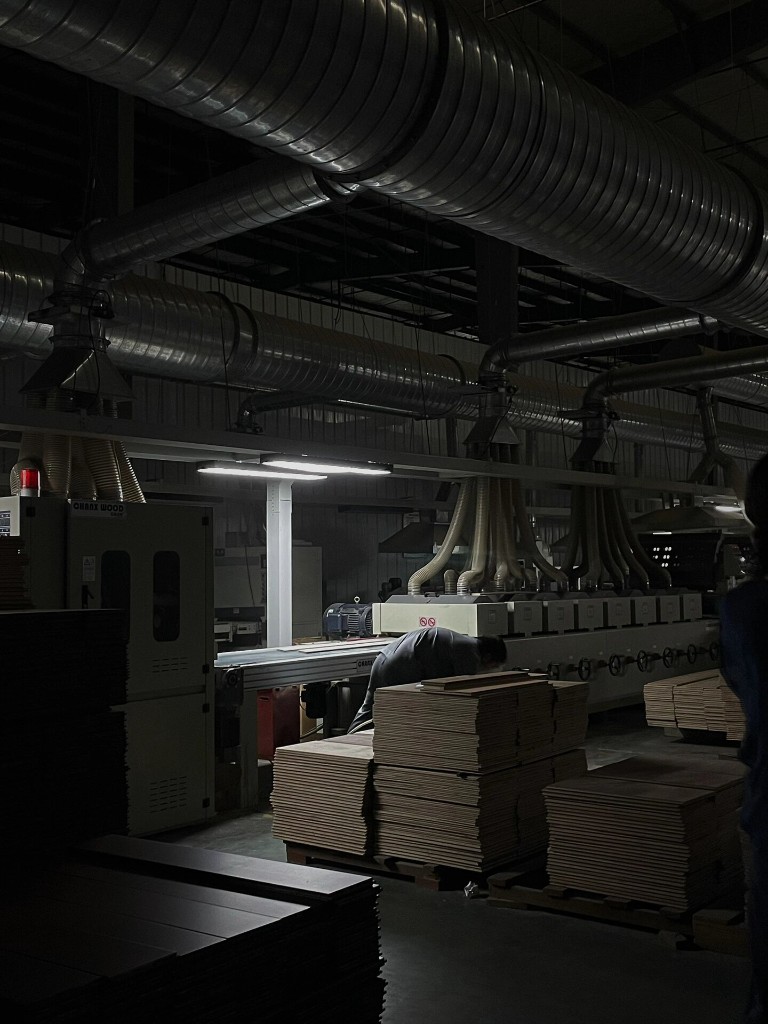
The result is a moisture gradient. Cartons on the outer pallet positions and near the doors can drift 2–4 percentage points from the factory target, while center-stacked cartons may move far less. Open a container and you are not looking at one batch of flooring — you are looking at a range.
Install that range directly and the consequences are predictable: gaps at the seams during the heating season, cupping or crowning when the planks equalize on the floor, and squeaks or edge-lift at the joints. The failure is not visible on delivery day. It appears 60 to 180 days after installation, which is precisely why the acclimation step cannot be skipped.
Conditioning — sometimes called balancing or equalization — brings every plank in the shipment back to a single, stable moisture content matched to the building it will live in. It is not an optional courtesy. It is the step that converts a manufactured product into an installed floor.
How Liancheng Controls Moisture From Kiln to Container
Our process is built around one objective: reduce the gap between factory MC and site EMC as far as physics allows.
Kiln drying and equalization. Green lumber enters computer-controlled kilns for 12–18 days depending on species and thickness. The drying schedule drops the charge to 8–10% MC, then holds it in an equalization phase for 24–48 hours so that shell and core moisture converge. A plank with a dry shell and a wet core will pass a surface meter test and still cup after installation — the equalization phase exists to prevent exactly that.
Post-machining verification. After profiling, every production lot is tested with calibrated resistance and capacitance meters. Our engineered planks ship at 7–9% MC; solid planks at 8–10%. These targets align with the dimensional stability requirements of EN 14342, the harmonized European standard for wood flooring. We record the readings against lot numbers, and those records are available to buyers on request.
Packaging as a moisture barrier. Planks are wrapped in PE film with edge protection and desiccant where required, then palletized and strapped. Packaging slows moisture exchange; it does not stop it. That is why we advise every buyer to treat the container as the beginning of the acclimation window, not the end of the manufacturing process.
[IMAGE: engineered oak plank with FSC C012 100 badge and calibrated moisture meter reading 8.2%]
Liancheng operates under an ISO 9001 quality management system, and our export volume exceeds 400 containers per year. At that scale, moisture control is a statistical process, not an artisanal one — 400 containers means 400 chances for a deviation to reach a customer, and the documentation system exists to catch deviations before they ship. For a fuller breakdown of how these systems are audited, see our guide to Link: Wood Flooring Certifications Explained.
Moisture Targets by Product Type
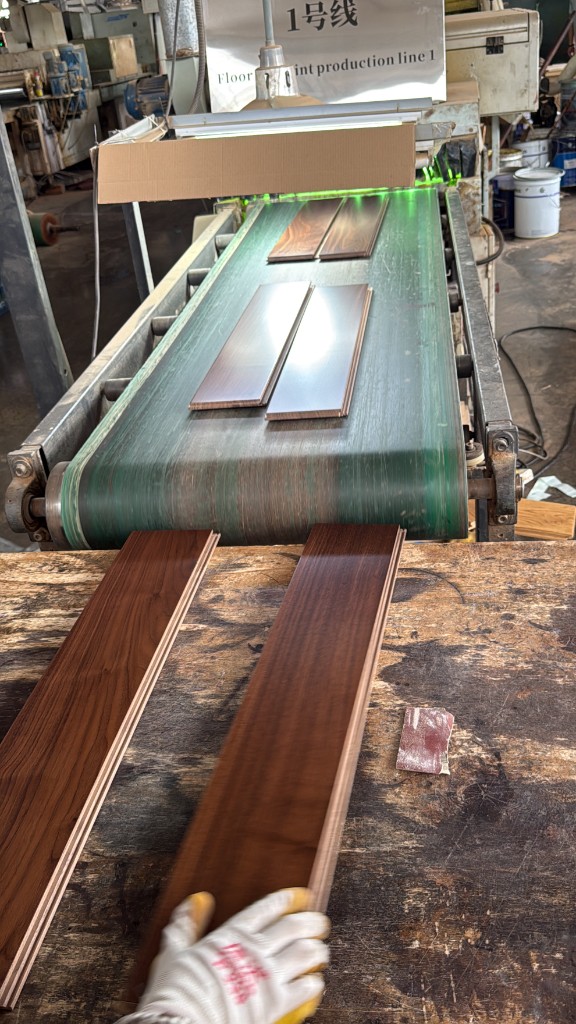
Different constructions tolerate moisture differently. The table below reflects the targets Liancheng applies for export production; site EMC values assume conditioned indoor space.
| Product type | Target MC at packing | Typical service EMC | Recommended on-site conditioning | Construction note |
|---|---|---|---|---|
| Engineered oak, 3-layer | 7–9% | 6–12% | 48–72 hours | Cross-ply core limits movement to roughly one-third of solid |
| Engineered oak, multi-layer | 7–9% | 6–12% | 48–72 hours | HDF core per JIS A 5905 fibreboard specification |
| Solid oak / teak, 18 mm | 8–10% | 6–12% | 72–120 hours | Full-width movement; wider planks need longer equalization |
| Engineered, heated floor | 6–8% | 5–9% | 72 hours minimum | Lower target because screed EMC is lower in radiant systems |
| Solid, tropical species | 8–10% | 7–13% | 72–120 hours | Higher density slows moisture uptake and release |
Two observations from our production data. First, engineered planks are not immune to moisture — they are simply more forgiving. A 4 percentage point MC spread in a solid 190 mm plank creates noticeably more stress than the same spread in a cross-ply engineered plank. Second, the target at packing should never be set arbitrarily; it should be set against the destination market's average indoor EMC. A floor bound for Dubai and a floor bound for Oslo should not leave the factory at identical moisture content.
Standards and Certifications That Govern Moisture, Emissions, and Wear
Moisture content does not exist in isolation. It interacts with dimensional stability, formaldehyde emissions, and surface performance, and each of those is governed by a published standard.
EN 14342 is the harmonized European standard for wood flooring. It defines how moisture content, dimensional stability, and surface characteristics are evaluated, and it underpins CE marking for wood flooring. A CE declaration without EN 14342 test data is incomplete.
CARB Phase 2 sets formaldehyde emission limits for composite wood products sold in California: 0.05 ppm for hardwood plywood, 0.09 ppm for particleboard, 0.11 ppm for MDF, and 0.13 ppm for thin MDF. The full limits are published in the CARB composite wood fact sheet. Moisture and emissions are linked — press conditions and resin chemistry affect both.
FSC C012 100 is our chain-of-custody certificate, verifiable through FSC certified wood flooring records. It documents that certified material is tracked from forest to finished pallet.
JIS A 5905 covers fibreboard performance for our HDF-core engineered planks, including density and swelling behavior under moisture exposure. ASTM D4060 measures coating abrasion resistance using the Taber abraser — relevant because a moisture-stressed surface fails faster under foot traffic. EN 13501-1 classifies our flooring as Bfl-s1 for reaction to fire, the standard classification for flooring materials.
Together these certificates answer the question a specification writer actually asks: not "is this floor dry?" but "can you prove, with a third-party number, that this floor will stay stable in my building?"
How to Condition Imported Flooring On Site: Five Checks
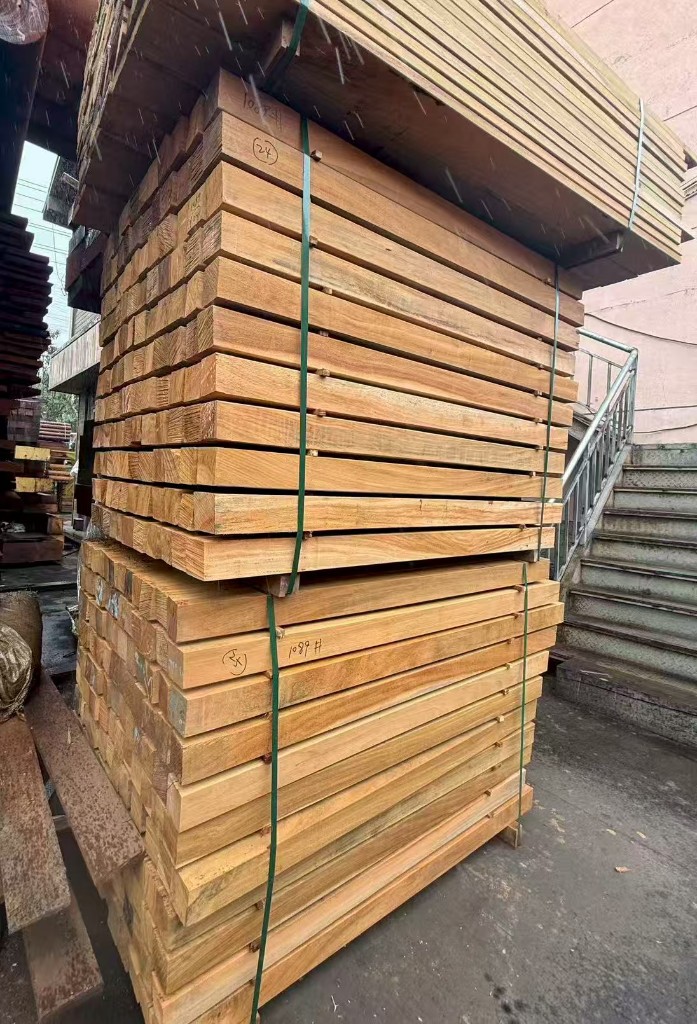
- Measure before you open. Take readings from at least three cartons per pallet, and from cartons near the container doors as well as center-stacked cartons. Record the range, not just the average.
- Condition in the installation room. Stack cartons on dunnage at least 50 mm off the slab, with 100–150 mm air gaps between packs. Never condition in an unconditioned warehouse and then move the floor into a climate-controlled room.
- Match the service EMC, not the factory number. Target the EMC of the finished, occupied space. If the building is still under construction and HVAC is not running, acclimation is not complete.
- Check the substrate. A concrete slab must be tested for moisture — the widely used threshold is 2.0% CM (calcium carbide) or 75–80% RH with in-situ probes before wood flooring is laid.
- Log the numbers. Record date, location, meter type, and readings for each zone. If a claim arises later, this log is the evidence that decides it.
For radiant-heated floors, add 24 hours to every window in the table above and ramp the system temperature gradually. For a deeper look at construction choices that affect stability, see the Link: Engineered Wood Flooring Guide.
[IMAGE: stacked engineered wood flooring cartons on dunnage with desiccant and moisture log sheet]
FAQ: Wood Flooring Moisture Content and Acclimation
What moisture content should engineered wood flooring be at installation? Between 6% and 9% for most conditioned interiors, matched to the room's equilibrium moisture content. At 20°C and 50% RH, wood EMC is approximately 9.2%; at 30% RH it falls to about 6.3%. Liancheng ships engineered planks at 7–9% MC per EN 14342 test methods.
How long does imported flooring need to acclimate? A minimum of 48–72 hours for engineered planks and 72–120 hours for solid planks, measured from the moment cartons are opened in the installation room. Add 24 hours for radiant-heated floors. Conditioning is complete when the plank MC stabilizes within 1 percentage point of the service EMC — not when a fixed number of days has passed.
Can a moisture meter tell me everything I need to know? No. Handheld meters read surface and near-surface moisture and are species- and temperature-sensitive. They are useful for relative comparison across cartons and for logging trends. Where disputes are possible, use oven-dry testing per EN 14342 methods on cut samples, or a calibrated resistance meter with species correction.
Does the ocean voyage actually change the moisture content of packaged flooring? Yes. A 25–40 day voyage with internal container temperatures swinging from 15°C to 60°C and relative humidity from 65% to 95% can move outer-carton moisture by 2–4 percentage points. PE wrapping and desiccants slow the exchange but do not eliminate it, and the variation across a container is often larger than the variation within a single lot.
Does CARB Phase 2 compliance relate to moisture content? Indirectly. Formaldehyde emissions in composite cores are influenced by press moisture and resin chemistry, which is why CARB Phase 2 limits — 0.05 ppm for hardwood plywood and 0.11 ppm for MDF — are tested alongside physical property data. Liancheng maintains CARB Phase 2 compliance documentation alongside ISO 9001 and FSC C012 100 records.
The Bottom Line on Wood Flooring Moisture Content
Wood flooring moisture content is the variable that decides whether an imported floor performs for 20 years or fails in the first heating season. Manufacturing to 7–9% and packing to a documented specification is necessary — but it is only half the job. The other half happens in your building, during conditioning, when the planks are brought into equilibrium with the space they will occupy.
Liancheng Wood Industry has produced engineered and solid flooring in Nanxun, Huzhou, Zhejiang since 1983, exporting over 400 containers per year under ISO 9001, FSC C012 100, CE EN 14342, CARB Phase 2, JIS A 5905, ASTM D4060, and EN 13501-1 Bfl-s1 certification. For custom wood flooring OEM programs, our technical team will match factory moisture targets to your destination climate before the first container is packed — Link: Contact Liancheng Factory to start that conversation.