沙特客户来访:他们如何审查中国工厂
How a Saudi Hospitality Developer Verified Our Wood Floor Factory: 42 Checkpoints, 4 Days, 13,847 m² of Saga Villas Engineered Oak <! Article schema: @type Arti…
How a Saudi Hospitality Developer Verified Our Wood Floor Factory: 42 Checkpoints, 4 Days, 13,847 m² of Saga Villas Engineered Oak
On 9 November 2025, a Riyadh-based hospitality developer spent four days inside our Nanxun plant auditing 42 checkpoints — then placed a 13,847 m² engineered oak order with Liancheng Wood Industry (Zhejiang) Co., Ltd.
That is the short version. The long version is the one procurement managers actually need, because "how to verify a wood floor factory" is never answered by a brochure, a price list, or a 40-minute video call. It is answered by standing on the kiln floor with your own moisture meter at 7:40 in the morning.
This article is our factory-side record of that audit: what the buyer asked, what we opened, what we measured, and what changed in our process afterwards. We are Liancheng Wood Industry (Zhejiang) Co., Ltd., founded in 1983 in Nanxun, Huzhou, Zhejiang Province, China. Our international brand is Saga Villas (世家华墅). We operate a 60,000 m² production base with 400 employees and export more than 400 containers a year. The questions this Saudi buyer asked are the same questions we receive from designers in Valencia and distributors in Rotterdam — which is why we wrote them down.
Project Background: Why a Saudi Developer Flew to Nanxun to Audit Saga Villas
The buyer is a hospitality developer with three properties under refurbishment on the Red Sea coast, totalling 480 guest rooms, corridors, and lobby areas. Their first inquiry arrived through our website on 22 July 2025, and by August 2025 we had shipped a 1 m² sample panel plus three 190 mm boards by DHL — sample lead time, 7 working days.
Their technical concern was specific and correct. Jeddah sits at relative humidity levels that can reach 85% in late summer, while hotel interiors run air conditioning for most of the year, pulling interior humidity down toward 30%. A floor that is not dimensionally stable through that cycle will cup, gap, or delaminate within 18 months. Before contacting us, their team had already visited three factories across two Chinese provinces. They arrived on 9 November 2025 with their own digital calipers, a pin-type moisture meter, and a 42-point checklist covering documentation, raw material, machinery, quality control, packing, and shipping.
We arranged a prayer room on site, halal catering for the four-day visit, and moved the Friday working schedule so that no audit step fell on prayer time. The audit ran 9–12 November 2025, from 08:00 to 17:30 daily.
Product Specification: 190 mm Engineered European Oak, 15/4 mm
The specification that came out of the audit was not the cheapest option quoted, and that was a deliberate buyer decision.
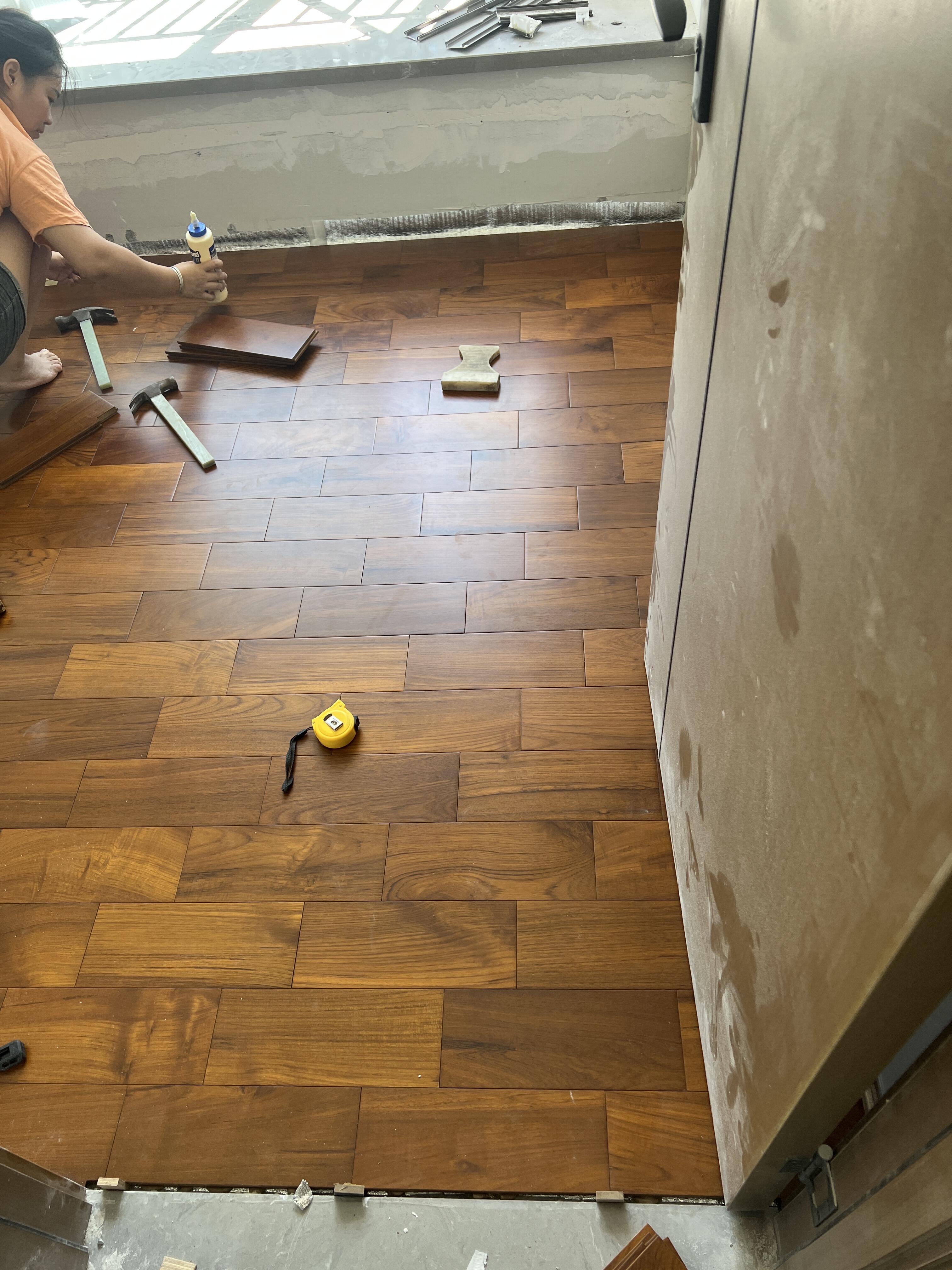
- Construction: 15 mm engineered, 4 mm sawn European oak wear layer, 11 mm multilayer cross-ply core (eucalyptus/poplar)
- Dimensions: 190 mm × 1,900 mm × 15 mm, micro-bevel 1 mm
- Grade: AB / Select, wire-brushed surface
- Finish: six-coat UV-cured lacquer, matte 8–10 gloss units
- Moisture content: 8–10% equilibrium moisture content at packing
- Tongue & groove tolerance: ±0.1 mm on width and thickness
- Reaction to fire: EN 13501-1, Bfl-s1 class
- Formaldehyde: CARB Phase 2 compliant, E0-grade adhesive
- Abrasion: tested to ASTM D4060
- Chain of custody: FSC C012 100
- CE marking: EN 14342 Declaration of Performance issued per batch
The client's technical director verified each certificate number directly on the issuing body's public register rather than accepting scanned PDFs — including the FSC certificate database at FSC certificate database and the EN 14342 harmonised standard documentation published through CE marking and EN 14342 compliance. We keep all current certificates listed on our [Link: Wood Flooring Export Certifications] page → https://www.floormfg.com/certifications so buyers can pre-screen before booking travel.
The 4 mm sawn wear layer was the deciding specification. It supports two full sanding and refinishing cycles, which fits a hotel refurbishment calendar better than a 2 mm veneer. Full dimensions and grades are listed in our [Link: Liancheng Engineered Flooring Catalog] → https://www.floormfg.com/products/engineered.
[IMAGE: Engineered European oak flooring, AB grade, 190 mm × 15/4 mm, wire-brushed surface with matte UV lacquer finish — factory sample board photographed in Nanxun]
Production Process: What the Auditor Watched Across 9 Stages
We did not present a showroom. The audit walked nine actual production stages, in sequence, on live orders — not a staged line.
1. Raw material selection. The client reviewed log intake records for the 8 m³ of European oak lamella designated for their order, checking species, origin documentation, and defect rate. Kiln charge number, log batch, and FSC transfer claim were cross-referenced three ways.
2. Kiln drying. Lamella is dried to 8–10% moisture content over a 21-day schedule. The auditor read the kiln controller log directly, then took 30 separate pin-meter readings across the charge. The highest reading was 9.6%; the lowest, 8.2%. Every reading fell inside specification.
3. Cross-ply assembly. Core layers are glued and pressed with E0-grade adhesive, alternating grain direction, then stress-relieved before the top layer is applied. This is the step that decides whether a floor survives Jeddah's humidity swing.
4. Calibration and sanding. Two calibration passes to ±0.05 mm thickness consistency across the panel.
5. Profiling. Four-sided profiling produces the tongue and groove. This was the most heavily scrutinised stage: the client took 20 caliper measurements of groove width and tongue thickness across 20 random panels. All 20 results landed within ±0.1 mm. Our operators log a caliper check every 30 minutes on every line, and those logs were handed over without prior notice.
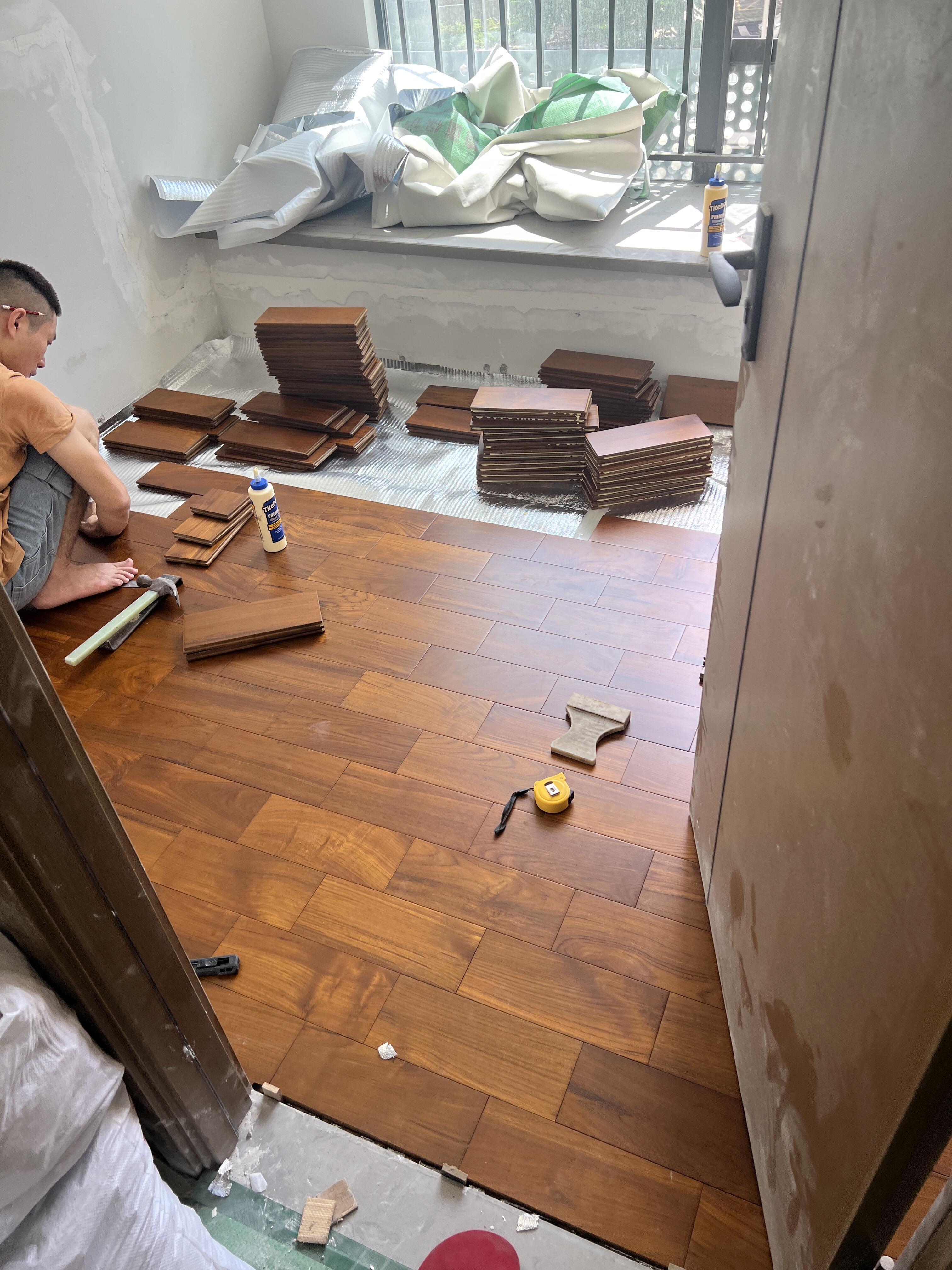
6. Wire-brushing and surface preparation. Mechanical brushing opens the grain to a consistent depth, which matters for lacquer adhesion.
7. UV lacquer line. Six coats, each UV-cured before the next application, with an intermediate sanding step.
8. Acclimatisation. Finished boards rest a minimum of 72 hours in a controlled 22°C / 50% RH room before packing.
9. Packaging. Shrink-wrapped pallets, 1.2 m × 1.0 m footprint, edge protection on all four corners, 18 pallets per 40' high-cube container.
Our solid wood production runs alongside this line for projects requiring single-species solid boards; that range is described in the [Link: Liancheng Solid Wood Flooring Catalog] → https://www.floormfg.com/products/solid-wood.
Quality Control: What Liancheng Wood Industry Opened to the Auditor
Our quality management system is certified to ISO 9001:2015, and the auditor confirmed the certificate's scope — manufacture of engineered and solid wood flooring, Nanxun, Zhejiang — against the certification body's public register before the site visit began.
On site, we ran nine inspection gates: incoming lamella, moisture verification, core assembly, thickness calibration, profile tolerance, surface finish, lacquer adhesion (cross-hatch test), packed-pallet inspection, and pre-shipment container check. In the laboratory, the client watched a Taber abrasion test to ASTM D4060, a formaldehyde chamber check, and a dimensional stability test simulating a 30% to 85% relative humidity cycle.
Third-party verification: SGS attended our facility on 24 February 2026 for a pre-shipment inspection of the 13,847 m² batch, using AQL 2.5 sampling. Result: zero major defects, two minor observations — an Arabic-language label requirement on the outer cartons and an increase in desiccant quantity per container. Both were closed within 5 working days, and both changes are now standard on every Middle East shipment we produce.
Client audit findings: our own record of the November 2025 visit shows 40 of 42 checkpoints passing on first review, with the two open items being the same packaging points later raised by SGS. We publish that number rather than a perfect score because buyers should expect a factory to have findings, and should judge it on how fast those findings close.
We also opened our social compliance documentation without being asked: employment contracts, dormitory conditions, working hours, and building ownership. The plant and land are owned outright, not leased — a point this buyer specifically wanted confirmed, because a leased facility creates continuity risk over a multi-phase hotel rollout.
Shipping & Delivery: 6 Containers from Ningbo Port to Jeddah Islamic Port
- Purchase order signed: 28 November 2025
- Production window: 1 December 2025 – 20 February 2026
- Third-party inspection: 24 February 2026 (SGS)
- Container loading: 6 March 2026 — 6 × 40' high-cube containers, 18 pallets each, 8 desiccant units per container
- Route: Ningbo Port → Jeddah Islamic Port, approximately 22 days transit, estimated arrival 28 March 2026
- Documentation released with the shipment: commercial invoice, packing list, bill of lading, FSC transfer documentation under C012 100, EN 14342 Declaration of Performance, SGS inspection certificate, and installation and acclimatisation guidance in English and Arabic
Weather during the loading week was 12°C with 68% RH — dry enough that we did not need to delay stuffing, a decision we document for every container because loading a floor into a humid container is one of the most common causes of complaint claims we see from other suppliers' shipments.
For buyers routing to other regions, our standard lanes include Ningbo → Rotterdam, Ningbo → Dubai (Jebel Ali), and Ningbo → Barcelona / Valencia, with transit times of 28–35 days depending on the service. We ship 400+ containers a year across these routes.
After-sales support for this project includes a 5-year commercial warranty, 2% attic stock retained at the factory for future repairs, and a factory-supplied moisture meter calibration protocol so the client's maintenance team can verify subfloor conditions before each future installation phase. Our installation guidance is issued with every container; technical support is available through [Link: Request Factory Sample] → https://www.floormfg.com/contact.
Conclusion: What a Factory Audit Actually Proves
A four-day factory visit does not prove that a supplier is cheap. It proves something more useful: whether the numbers on the certificate match the numbers on the production floor.
For the Saudi hospitality developer who spent 9–12 November 2025 with us, the audit produced a 13,847 m² order, six containers, zero major third-party findings, and a supplier relationship that now covers their second and third properties. For us at Liancheng Wood Industry (Zhejiang) Co., Ltd., it produced two packaging improvements that we now apply to every Middle East shipment — which is exactly what a good audit should do for both sides.
If you are preparing to verify a wood floor factory in China, these are the checks that carried the most weight in this case:
- Read the kiln log yourself and take your own moisture readings. 8–10% equilibrium moisture content at packing is the target; anything above 12% is a claim waiting to happen.
- Measure the tongue and groove with your own calipers, on random panels, not on the sample the factory selected. ±0.1 mm is achievable and should be verified on the line, not in a showroom.
- Look up every certificate number. FSC chain of custody, CE / EN 14342, ISO 9001, CARB Phase 2, JIS A 5905, ASTM D4060, and EN 13501-1 Bfl-s1 ratings are all verifiable through issuing bodies and public registers.
- Ask who owns the building, how many containers the factory shipped last year, and how many people it employs. Founded in 1983 with 400 employees, 60,000 m² of production space, and more than 400 containers a year is a verifiable answer — "we are a large factory" is not.
- Insist on third-party inspection before shipment. SGS or Bureau Veritas attendance at loading is inexpensive relative to a rejected container.
We host buyer audits year-round at our Nanxun facility, roughly 90 minutes by road from Ningbo Port and two hours from Shanghai. If you are planning a sourcing trip and want the same 42-point walkthrough this Saudi developer received — including kiln logs, caliper measurements, and third-party inspection records — start with a sample and a factory visit request through [Link: Request Factory Sample] → https://www.floormfg.com/contact, or review our certification set at [Link: Wood Flooring Export Certifications] → https://www.floormfg.com/certifications before you book flights.
Liancheng Wood Industry (Zhejiang) Co., Ltd. — Saga Villas — Nanxun, Huzhou, Zhejiang Province, China. www.floormfg.com