柚木为什么是木地板之王:含油量与稳定性的关系
Teak Wood Flooring: The King of Hardwood — Oil & Stability <! Article schema: @type Article, author: Liancheng Wood Industry, publisher: www.floormfg.com Teak w…
Teak Wood Flooring: The King of Hardwood — Oil & Stability
Teak wood flooring packs 2–6% heartwood oil, roughly 4.2% tangential shrinkage and a 1,070 lbf Janka rating — covered by FSC C012 100 chain of custody at Liancheng Wood Industry. That single combination explains why the species still outperforms oak, walnut and maple in humid, high-traffic and coastal interiors after decades in service. Liancheng Wood Industry (Zhejiang) Co., Ltd., founded in 1983 in Nanxun, Huzhou, Zhejiang Province, has milled hardwood under the Saga Villas brand for 43 years and exports more than 400 containers annually.
Most flooring species are sold on hardness alone. Teak is sold on hardness plus chemistry: the same natural oils that make it rot-resistant also make it move less. For an engineered wood flooring manufacturer, that chemistry decides whether a floor gaps during a monsoon season or stays flat from the first winter to the tenth. This guide explains the mechanism — not just the reputation — and shows how we test, certify and specify teak for importers, distributors and private-label programs.
[IMAGE: Saga Villas engineered teak wood flooring, natural finish, FSC C012 100 certification badge]
What Makes Teak Wood Flooring the King of Hardwoods
Mature teak heartwood is classified in the highest natural durability class under EN 350, meaning it resists fungal decay and termites without chemical treatment. The species, Tectona grandis, grows across India, Myanmar, Thailand, Laos and Indonesia, and produces a heartwood saturated with extractives that most commercial hardwoods simply do not have. Those extractives are not a surface treatment — they are grown into the wood over 25 to 80 years of tree life.
The dominant compound is tectoquinone, a naturally occurring quinone that suppresses fungal growth and insect attack. A second family of extractives — oils, resins and waxes — fills the cell lumens and coats the cell walls. Understanding the difference between "teak is water-resistant" and "teak is water-resistant because of what is inside the cell" matters commercially, because only the second statement tells you what happens after sanding, resurfacing or a decade of cleaning.
Hardness is where teak loses the spec-sheet war and wins the application war. At 1,070 lbf on the Janka scale, teak is softer than white oak at roughly 1,360 lbf and hard maple at roughly 1,450 lbf. Yet hardness predicts dent resistance, not gap resistance. Teak's advantage sits in moisture movement, and moisture movement is what destroys floors in humid markets. Our factory has produced teak planks for projects in Southeast Asia, the Middle East and coastal Europe where oak installations failed within two heating seasons — not because oak is weak, but because oak moves.
Teak also contains silica, which is why the species dulls cutting tools faster than most hardwoods. That detail is not trivia for buyers: it is the reason teak must be milled on tooling maintained to tighter intervals, and the reason low-cost teak flooring sometimes shows torn grain and inaccurate tongue profiles. Tool wear is a quality variable, and it shows up in the finished joint.
Teak Oil Content and Dimensional Stability: How the Chemistry Works
Wood moves because water bonds to hydroxyl groups in the cell wall. When humidity rises, water molecules attach to those sites, the cell wall swells, and the board expands; when humidity falls, the reverse happens and the board shrinks. Teak's extractives occupy many of those sites and physically block part of the cell wall from moisture access, so the wood takes on and releases less water at any given relative humidity.
That is the entire mechanism behind teak's stability, and it is measurable. Published wood-science data place teak's tangential shrinkage from green to oven-dry at approximately 4.2%, with a tangential-to-radial ratio near 1.6 — a low ratio, which means teak distorts less in service than species with high T/R ratios. Compare that with white oak at roughly 10.5% tangential shrinkage, black walnut near 7.8% and hard maple near 9.9%, and the ranking reverses completely from the Janka table.
The oils also slow moisture uptake at the surface, which is why teak finishes evenly and why it tolerates occasional surface wetting better than most hardwoods. It is important to be precise here: teak is not waterproof, and a teak floor in a bathroom will still fail if water reaches the core. What the oils provide is a slower moisture response curve — more time for the floor to reach equilibrium with its environment without visible movement.
Kiln drying converts this natural advantage into a manufactured one. We dry teak to a target moisture content of 8–10% before milling, because a plank shipped at 14% moisture will shrink after installation regardless of how much oil it contains. Drying schedules for teak are slower than for oak: the extractives slow moisture migration out of the heartwood, and aggressive schedules cause case-hardening and internal checking that only appear after the floor is laid. Drying discipline is invisible in a sample box and decisive in a container.
Teak vs. Oak, Walnut and Maple: Stability by the Numbers
The table below compares the species most frequently specified against teak in commercial and residential projects. Shrinkage values are published tangential movement figures from green to oven-dry condition; Janka ratings are standard side-hardness values.
| Species | Janka hardness (lbf) | Tangential shrinkage | Natural oil / extractive content | Typical best-fit application |
|---|---|---|---|---|
| Teak (Tectona grandis) | 1,070 | ~4.2% | 2–6% in mature heartwood | Humid, coastal and high-traffic luxury interiors |
| White oak | 1,360 | ~10.5% | Low | General residential, dry-climate projects |
| Black walnut | 1,010 | ~7.8% | Low | Dry interiors, furniture-grade visual work |
| Hard maple | 1,450 | ~9.9% | None | Sports floors, controlled indoor environments |
The practical reading: if a project specifies by hardness, maple wins. If a project specifies by dimensional stability and service life in a variable-humidity building, teak wins by a wide margin. Buyers who have replaced cupped oak floors in a coastal hotel understand that the second specification is the one that determines warranty exposure.
How Liancheng and Saga Villas Manufacture Teak Wood Flooring
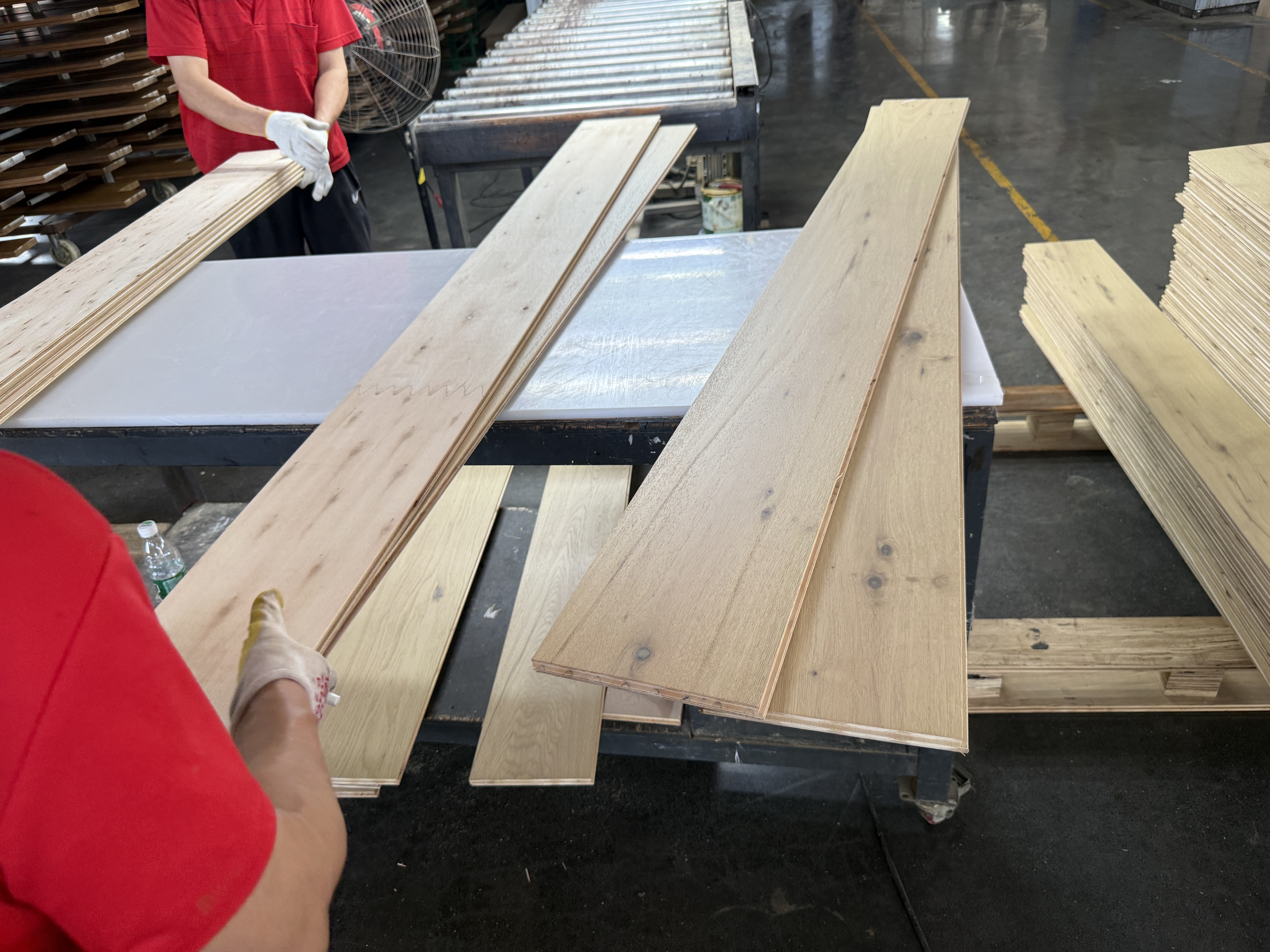
We produce teak flooring in two constructions. Solid teak planks deliver the full thickness of the species and are specified for ground-floor and heritage work. Engineered teak planks bond a teak wear layer to a dimensionally stable plywood core, which reduces movement further and is the construction we recommend for radiant heating, large-format planks and high-rise applications. The Engineered Wood Flooring Guide explains how core construction interacts with wear-layer species selection.
Production runs in six controlled stages: log grading and heartwood selection, sawing to grain orientation, kiln drying to 8–10% moisture content, profiling of the tongue-and-groove joint, sanding and finishing, then final inspection and packaging. Joints are cut on calibrated tooling and checked against gauges before each run, because teak's silica content accelerates tool wear and an out-of-tolerance joint shows up as squeaks and gapping later.
Finishing is where teak requires a specific decision. Because the wood's own oils can interfere with penetrating oil finishes, we apply UV-cured coatings that bond predictably and cure in-line, giving a consistent film across the entire production batch. Abrasion resistance is verified against ASTM D4060, the standard Taber abrasion method for organic coatings, so the wear performance of a delivered floor can be traced back to a test result rather than a marketing claim.
We operate an ISO 9001 quality management system across the Nanxun plant, with documented process control at drying, profiling and finishing. For buyers running a private-label program, the same lines support custom wood flooring OEM runs — species, width, length, grade, bevel, surface texture and packaging specified by the customer and locked to a signed sample.
[IMAGE: teak oil content and dimensional stability comparison chart, teak vs white oak, CE EN 14342 and CARB Phase 2 badges]
Certifications Every Hardwood Floor Supplier in China Should Prove
A certificate is only useful when it names a scope, a number and a body that can be verified. The following credentials apply to our teak flooring programs, and any serious hardwood floor supplier China buyers evaluate should be able to produce equivalents on request.
Chain of custody is the first gate. Our FSC certified wood flooring status runs under certificate code FSC C012 100, which means the fibre in a labeled carton can be traced back through the supply chain to a responsibly managed forest. This matters commercially because EU and North American tender documents increasingly disqualify unverifiable timber before price is even discussed.
Market access is the second gate. CE marking under EN 14342 is the harmonized European standard for wood flooring and governs reaction to fire, formaldehyde release, pentachlorophenol content and breaking strength. Our systems are qualified to EN 13501-1 fire class Bfl-s1, the flooring classification with limited combustibility and low smoke production required for many commercial interiors.
Air quality is the third gate. CARB Phase 2 sets formaldehyde emission limits for composite wood products sold in California, at 0.05 ppm for the hardwood plywood cores used in engineered construction. Japan applies a parallel framework, and our cores are produced to JIS A 5905 requirements for fibreboard performance. Combined with ISO 9001 process control, these standards are what allow a teak floor to clear customs, pass an importer's QA audit and stay on a specification list.
Specifying Teak Wood Flooring: OEM and Import Guide
Start with the environment, not the sample. Buildings with year-round humidity above 65% relative humidity should use engineered construction with a stabilized core; buildings with radiant heating should use engineered construction regardless of climate. Solid teak remains the right answer for heritage restoration and ground-floor installations with stable indoor conditions.
Then specify grade and color honestly. Mature heartwood ranges from golden brown to deep amber and darkens with light exposure. Sapwood is pale and, because it lacks the extractives that define teak's performance, should be excluded from the wear surface in premium grades. If a quote offers uniform pale teak at a discount, the specification has usually changed, not the price.
Finally, request test documentation with the quotation: FSC C012 100 chain-of-custody evidence, EN 14342 declaration of performance, EN 13501-1 classification, CARB Phase 2 test reports and ASTM D4060 abrasion results. To discuss a program, Contact Liancheng Factory directly — specifications, samples and container schedules are handled by our export team in Nanxun.
Frequently Asked Questions
Does teak wood flooring need oiling? No. Factory-applied UV-cured finishes seal the surface, and teak's own extractives provide additional moisture buffering beneath the film. Recoating intervals depend on traffic; commercial installations typically refresh the topcoat before the film wears through, and ASTM D4060 abrasion results give a reasonable basis for planning that interval.
How much more stable is teak than oak? Teak's published tangential shrinkage is approximately 4.2%, against roughly 10.5% for white oak — meaning teak moves at roughly 40% of oak's rate across the grain. In variable-humidity buildings, that difference is the main reason teak floors stay flat while oak floors cup, gap and require replacement.
Is plantation teak as good as Myanmar teak for flooring? Plantation teak is typically harvested younger, so it carries less extractive content and lighter color than old-growth heartwood. It performs well in engineered construction and is the practical choice for most commercial programs. For premium solid flooring, we grade for heartwood proportion and density rather than origin marketing.
What certifications should accompany a teak flooring shipment? At minimum: FSC C012 100 for chain of custody, a CE declaration of performance to EN 14342 with EN 13501-1 Bfl-s1 fire classification for EU-bound material, and CARB Phase 2 reports for composite cores entering the United States. Japanese-market orders require JIS A 5905 documentation for fibreboard cores.
Conclusion
Teak earns the title of king not because it is the hardest floor on the market — it is not — but because its extractive chemistry makes it the most predictable one. Two to six percent heartwood oil, roughly 4.2% tangential shrinkage and a durability rating in the highest EN 350 class together produce a floor that survives humidity swings which destroy harder species. Liancheng Wood Industry (Zhejiang) Co., Ltd. has milled that species for 43 years, dried it to 8–10% moisture content, finished it under ISO 9001 control and shipped it in more than 400 containers a year under the Saga Villas brand. If you are specifying teak wood flooring for a humid, coastal or high-traffic project, the specification that protects your warranty is dimensional stability — and no commercial hardwood delivers more of it.